

2026 Meal Deduction Changes: What Businesses Need to Know
Most business owners don’t think about meal deductions until tax time—but the 2026 meal deduction changes could create unexpected impacts.
Recent tax law changes are quietly eliminating or limiting many common employer meal deductions, shifting how businesses should think about everyday expenses like team lunches, snacks, and on-site food.
Executive Summary
Starting in 2026, many employer-provided meals that were previously deductible will no longer be allowed as a tax deduction. While some business meals remain partially deductible, others—especially convenience meals and in-office food—become fully nondeductible. The real opportunity is no longer the deduction itself—it’s how expenses are planned, tracked, and structured throughout the year.
Not sure how your meal expenses will be treated in 2026?
Start with a simple decision guide and documentation checklist.
What Changed in Meal Deductions in 2026
Beginning January 1, 2026, several long-standing meal deductions have been eliminated under federal tax law.
Meals that are now nondeductible:
- Meals provided for the convenience of the employer
- On-site cafeterias and breakroom food
- De minimis snacks (coffee, snacks, occasional food)
Meals that are remain partially deductible:
- Business meals with clients or prospects (generally 50%)
Many everyday workplace food expenses are shifting from “routine deduction” to “fully taxable cost.”
Key Insight:
This isn’t just a tax change—it’s a visibility issue inside your financials. Most businesses don’t track meal expenses at a level detailed enough to apply these rules correctly.
See How Your Expenses Would Be ClassifiedCommon Real-World Scenarios
- Staff appreciation lunches — Generally nondeductible beginning in 2026
- Food ordered for internal meetings — Typically nondeductible
- Breakroom snacks and coffee — Nondeductible
- Client lunches — Still 50% deductible if properly documented
How Would Your Expenses Be Treated?
Not all meal expenses are treated the same. The outcome depends on purpose, structure, and documentation.
These 2026 meal deduction rules are best understood through a simple decision framework.
Use this decision guide to see how your expenses may be classified under the 2026 rules:
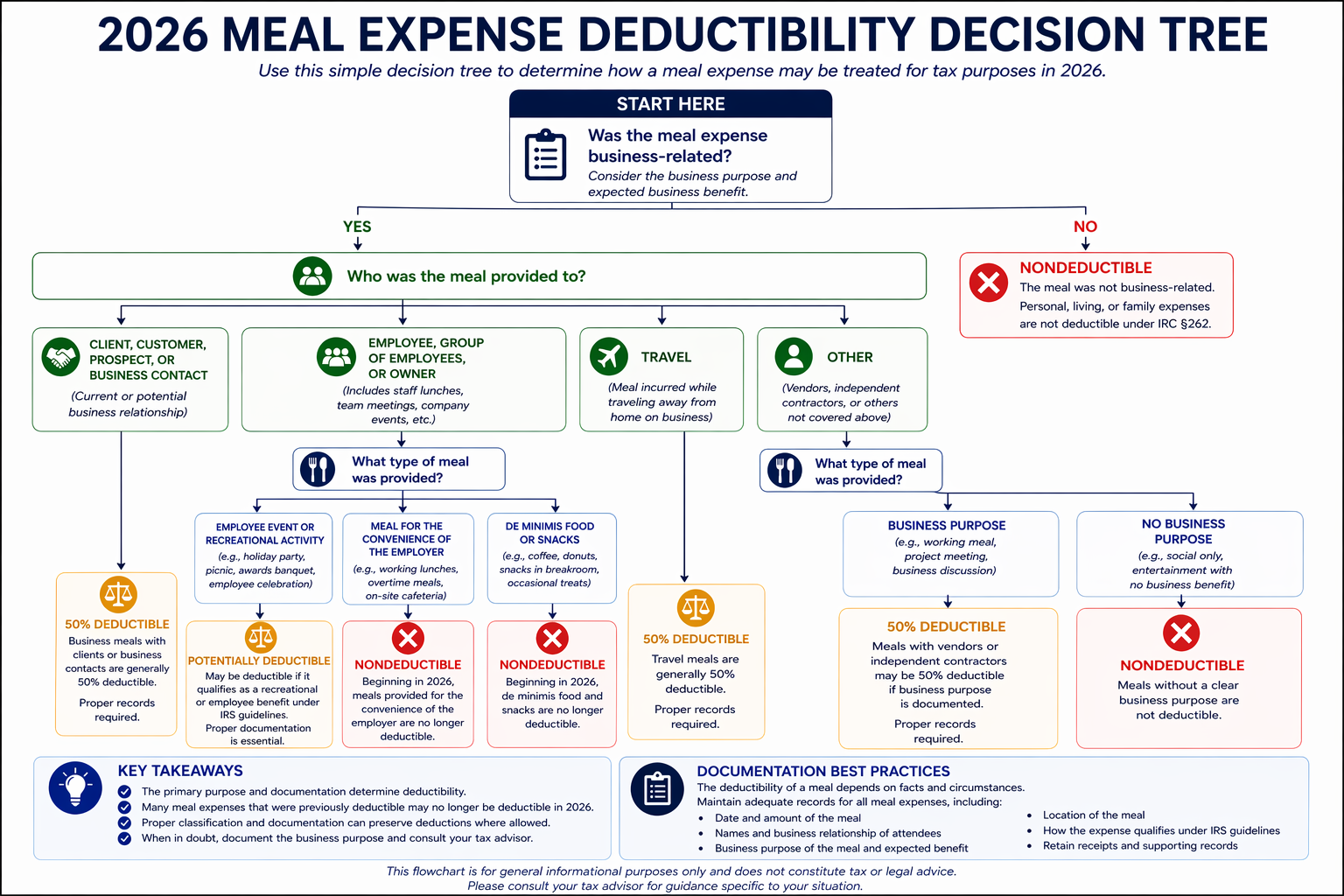
Want a printable version of this decision tree and a tracking checklist? Download the full guide below.
Where Strategy Still Creates Opportunity
At first glance, the 2026 changes feel like a simple loss of deductions. But in practice, the outcome depends heavily on how expenses are structured and documented. The same type of expense can be treated very differently for tax purposes depending on intent, documentation, and how it is categorized.
That means the outcome is no longer determined at tax time—it’s determined at the point the expense is recorded.
Example: Staff Appreciation Lunches
A typical team lunch may now be considered nondeductible if it is treated as a routine internal expense. However, in certain cases, similar expenses may still qualify for more favorable treatment when properly structured.
- Meals tied to company-wide events or structured employee activities may qualify differently
- Events that meet specific criteria (such as recreational or employee benefit classifications) may retain deductibility
- Proper documentation of purpose, attendees, and business intent becomes critical
What changes the outcome?
It’s not just the expense itself—it’s how it is framed and supported:
- Clear classification in the accounting system
- Consistent documentation of business purpose
- Separation between routine meals and structured events
- Alignment with IRS-defined categories
In other words, two businesses could spend the same amount on employee meals—and end up with very different tax outcomes.
The deduction isn’t gone—it’s conditional.
When expenses are planned and documented intentionally, opportunities still exist. When they’re not, deductions are simply lost.
This is where proactive planning—and structured financial systems like Client Accounting Services (CAS)—make the difference.
Download the Meal Deduction Guide
Compliance vs. Strategy
It’s easy to treat this as a compliance issue. But the more important question is how your business should adjust.
- Are meal expenses being categorized correctly in real time?
- Are deductible and nondeductible meals being clearly separated?
- Is management aware of the true after-tax cost of these expenses?
Advisory Perspective:
Most businesses don’t have a deduction problem—they have a tracking problem. Small classification issues can compound into larger reporting gaps.
How to Prepare for 2026
- Review and update expense categories in your accounting system
- Train staff on how to code meal-related expenses
- Separate internal meals from client-related meals
- Build reporting that reflects true after-tax costs
Closing Thought
The 2026 meal deduction changes are not dramatic on their own. But they are part of a broader shift from reactive tax compliance to proactive financial management. If you’re reviewing your financial systems after tax season, start with our post-tax reset checklist.
Not sure if your current setup supports these rules?
We’ll walk through your current process, identify gaps, and help you determine how to maximize your meal deductions.
Schedule a Meal Expense Review
This article is provided for general informational purposes and does not constitute legal or tax advice.