

Why Profitable Businesses Still Run Out of Cash
A business can be profitable on paper—and still feel like it’s constantly short on cash.
This is one of the most common (and most misunderstood) financial challenges business owners face.
After tax season, many owners review their results and think:
“We made money… so why does it still feel tight?”
The answer is almost never tax-related.
It’s operational.
Over the past several months, we’ve discussed payroll tracking, tax payment systems, funding readiness, and financial visibility. Cash flow is where all of those operational decisions finally intersect.
Executive Summary
Cash flow issues are rarely caused by a lack of profitability. Instead, they stem from how money moves through your business.
In most cases, the pressure comes from:
- Timing gaps between revenue and cash collection
- Limited visibility into upcoming obligations
- Operational decisions made without cash flow forecasting
- Inconsistent systems for managing receivables, payables, and payroll
Strong business cash flow visibility allows owners to make proactive decisions before financial pressure builds.
Profit Doesn’t Equal Cash
Your income statement tells you whether your business is profitable.
It does not tell you whether you have cash available when you need it.
That’s because profit includes:
- Revenue that hasn’t been collected yet
- Expenses that haven’t been paid yet
- Non-cash items like depreciation
In other words:
Profit is a calculation.
Cash is reality.
Timing is what determines whether a profitable business actually feels financially stable day to day.
A contractor may finish a profitable month on paper while still waiting on receivables, facing payroll on Friday, equipment payments on Monday, and quarterly taxes the following week.
A business can show strong profits and still struggle to:
- Make payroll comfortably
- Pay vendors on time
- Invest in growth opportunities
This disconnect is where most financial stress begins.
Where Cash Flow Actually Breaks Down
Cash flow issues don’t come from one big mistake.
They come from small breakdowns across the financial system.
1. Revenue Timing (Accounts Receivable)
You’ve earned the revenue—but you haven’t been paid yet.
Common issues include:
- Delayed invoicing
- Inconsistent follow-up
- Long payment cycles
This creates a lag between “earning” and “having.”
2. Expense Timing (Accounts Payable)
Bills are paid based on urgency—not strategy.
This often looks like:
- Paying everything immediately “to stay safe”
- Or delaying payments without a clear plan
Both approaches create unnecessary pressure on cash.
Tax payments often create additional pressure here because businesses may know an obligation is coming but have not proactively reserved the liquidity for it, as we discussed in our IRS Direct Pay overview.
3. Payroll Pressure
Payroll is usually the largest recurring expense in a business.
And it’s fixed.
Unlike other costs, it can’t easily be delayed or adjusted in the short term.
We also see:
- Overtime creeping in without planning
- Staffing decisions made reactively instead of strategically
Payroll is often where operational inefficiencies become financially visible first.
Even recent overtime reporting changes highlighted how important accurate payroll tracking and labor visibility have become for businesses managing recurring cash obligations.
4. Lack of Forward Visibility
This is the biggest issue.
Most businesses operate based on:
- Current bank balance
- Recent activity
Instead of:
- What’s coming in over the next 4–8 weeks
- What obligations are already committed
Without forward visibility, businesses begin making decisions based on stress instead of strategy.
Why This Becomes More Noticeable After Tax Season
Tax season creates a temporary sense of clarity.
You:
- Review your financials
- File your return
- See your results
But shortly after, the reality sets back in:
The tax return is backward-looking.
Your business operates forward.
That’s why post-tax season is often the ideal time to reassess cash flow systems, forecasting, and operational planning—not just tax strategy.
Tools like IRS Direct Pay can make executing tax payments more efficient.
But execution isn’t the issue.
The issue is:
- When the cash is available
- And whether the payment fits into your broader cash flow
Growth Makes This Worse—Not Better
Many business owners expect cash flow to improve as they grow.
In reality, growth often amplifies the problem.
Why?
Because growth requires:
- Hiring before revenue is fully realized
- Purchasing inventory or equipment upfront
- Extending credit to customers
As we discussed in our West Virginia funding overview, accessing capital requires structured forecasting and disciplined financial management.
Without that structure, growth can strain cash—even in a profitable business.
Access to capital may solve a temporary liquidity issue, but without cash flow discipline, growth itself can become the source of financial strain.
Cash Flow Is Where Operational Decisions Become Financial Pressure
Every operational decision affects the movement of cash through a business.
Businesses rarely lose financial stability all at once. More often, pressure accumulates gradually through operational decisions that were never evaluated through a cash flow lens.
Pressure builds on liquidity through:
- Payroll decisions
- Tax obligations
- Vendor payment terms
- Delayed invoicing and collections
- Hiring and growth initiatives
Without strong reporting and forward visibility, these pressures often remain hidden until they begin impacting day-to-day operations.
Cash flow problems are rarely isolated accounting issues.
More often, they are operational decisions showing up financially.
Cash Flow Pressure Often Builds Gradually
Most cash flow problems develop gradually through timing gaps, payroll pressure, delayed collections, and reactive decision-making. Our Cash Flow Visibility Worksheet helps business owners map upcoming inflows, obligations, and pressure points before they begin impacting operations.
Download the Cash Flow Visibility WorksheetWhat Strong Cash Flow Actually Looks Like
Stable businesses don’t eliminate variability—they manage it proactively.
A strong cash flow system includes:
- Clear visibility into cash position weekly
- Short-term forecasting (typically 4–13 weeks)
- Planned timing of receivables and payables
- Awareness of payroll impact on liquidity
- Consistent reporting rhythms and review processes
- Decision-making based on data—not bank balance
The goal isn’t perfection.
It’s predictability.
The Shift: From Reactive to Intentional
Most businesses operate in a reactive cycle:
- Cash comes in
- Bills get paid
- Payroll hits
- Cash gets tight
- Repeat
A more effective approach requires consistent visibility, forecasting, and operational planning across the business.
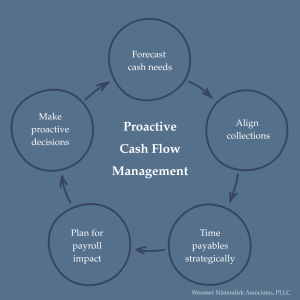
This shift allows businesses to make decisions proactively instead of reacting to financial pressure after it occurs.
Where This Fits Into the Bigger Picture
Over the past several months, we’ve talked about:
- Payroll and overtime tracking
- Tax payment systems
- Funding readiness
- Post-tax planning
- Financial visibility through CAS
While those topics may appear unrelated on the surface, they are all connected by the same underlying issue:
understanding how cash moves through a business operationally.
Cash flow is not a separate issue.
It is the operational foundation that everything else depends on.
Closing Thought
Most cash flow problems don’t come from a lack of income.
They come from a lack of structure.
Once you can clearly see:
- What’s coming in
- What’s going out
- And when it’s happening
You can start making decisions with confidence instead of reacting under pressure.
Predictability creates confidence.
That’s when a business begins to feel stable—not just successful.
Want a Clearer Picture of Your Cash Flow?
If your business is profitable but cash still feels unpredictable, the issue may not be revenue—it may be visibility.
We’ve created a Cash Flow Visibility Worksheet to help business owners identify timing gaps, recurring pressure points, and upcoming obligations before they create stress.
And if you need help building a more intentional reporting and forecasting structure, our team can help you create systems that support proactive decision-making—not just year-end reporting.
This article is provided for general informational purposes and does not constitute legal or tax advice.